
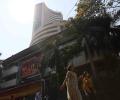
The National Stock Exchange (NSE) has got into firefighting mode to control the reputational damage caused by the Securities and Exchange Board of India's (Sebi's) order against its former managing director and chief executive officer Chitra Ramkrishna and others. According to sources, the exchange's management over the past one week has met several key stakeholders, including officials in the finance ministry and Sebi, major shareholders, and trading members, trying to distance itself from the controversy. The exchange plans to hold more meetings in the coming week to ensure that trading volumes and confidence in the bourse don't get impacted, they added.
Currently, trades on the Indian stock exchanges are settled within two days, just like most major markets such as Singapore, Hong Kong, Australia, Japan, and South Korea. Indian exchanges, however, will be moving to T+1 settlement from February 25 in a phased manner.

'Younger investors start their journey with very little capital so they are risking less while they have a lot of time to experiment and learn early on.'

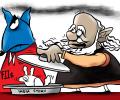
Illustration: Uttam Ghosh/Rediff.com After a brief respite at the year's start, FPIs have dumped shares worth more than $5.7 billion (Rs 42,596 crore), taking the cumulative net outflows since October to $10.5 billion (Rs 78,466 crore), and adding to the volatility on the bourses. The figure would have been a lot worse had it not been for net purchases to the tune of $5.7 billion in the primary market from October to date.

Despite the wobble in the markets over the past few weeks, Indian equities remain expensive as measured by several yardsticks. India's market capitalisation-to-GDP ratio, for instance, has touched a multi-year high. The ratio is currently at 116 per cent, based on the FY22E gross domestic product (GDP) number, above its long-term average of 79 per cent.
Retail investors have gained significant heft in the past year amid a sustained uptick in Indian equities. The share of retail investors in companies listed on the NSE reached an all-time high of 7.32 per cent in the quarter ended December 31, 2021, up from 7.13 per cent in the previous quarter and 6.9 per cent a year ago, the data from PRIME Infobase shows. This was despite the Nifty's 1.5 per cent decline during the quarter.

The proposal in the Finance Bill to amend provisions of Section 179 of the Income Tax (I-T) Act relating to tax liability of directors of private limited companies from April 1, 2022, could increase risks for directors of medium and small-sized firms in case of non-payment, said experts. While the language of the provision is quite broad, the title of the section limits itself to 'liability of directors of private companies in liquidation'. The Bill proposes to align the title with the scope of the provision, thereby ensuring that orders under this section can be issued even if the relevant company is not under liquidation.
Foreign portfolio investors (FPIs) who invest from Mauritius into Indian companies that dole out bonus debentures will get impacted by the tax avoidance provisions on bonus stripping. The FY23 Budget has extended these provisions - applicable only to MFs, so far - to shares and units of REITs, InvITs and AIFs. The move will especially affect large institutional investors who sell original units within nine months after the record date because the loss arising from sale of original units would have to be ignored for the purposes of computing taxable income and cannot be set off against any other capital gain.

Concessional rate of tax on dividends received by Indian companies from foreign subsidiaries will be done away with from April 1, a change that may hamper global expansion of Indian companies and compel some firms to move their headquarters out of India to geographies such as Singapore and Dubai. At present, dividends received by Indian companies from their foreign subsidiaries are subject to a concessional tax rate of 15 per cent under Section 115BBD of the Income Tax (I-T) Act. The provisions of this section shall not apply from assessment year 2023-24 onwards, according to the Finance Bill.

'Making money in such markets is typically harder and investors need to put in considerable effort to identify stock ideas over the year.'

'Largely, new demat accounts are now being opened by the younger crowd, particularly GenZ.' 'This is great news since younger investors start their journey with very little capital, so they are risking less.'

'India has entered an economic super-cycle driven by a housing cycle turnaround.'

'We never go overboard on any stock, no matter how good it may seem.'

The expected interest rate hike in the US and the resultant volatility in the domestic secondary market could play a dampener to the over Rs 2-trillion initial public offering (IPO) pipeline in 2022. IPOs in 2022 look promising, with as many as 35 companies holding the Securities and Exchange Board of India's approval to raise roughly Rs 50,000 crore. Another 33 companies are waiting for the regulator's nod to raise around Rs 60,000 crore next year.

'The IPO market is cooling off and getting a reality check.'

'It could tempt investors to pick stocks that are not fundamentally sound.'

The RBI's financial stability report has on Wednesday highlighted the disconnect between the real economy and equity market yet again. The central bank observed that Indian equities were trading at rich valuations, with several metrics such as price to earnings multiples, price to book ratio, market cap to GDP and the cyclically adjusted P/E ratio, or Shiller P/E, at above historical averages. For instance, as on December 13, the one-year forward P/E ratio for India was 35.1 per cent, above its 10-year average, and one of the highest in the world.

Of the 59 IPOs for which the data is available, 36 IPOs received mega responses of more than 10x (of which, six IPOs more than 100x), while eight IPOs were oversubscribed more than 3x.

A December 28 board meeting of the Securities and Exchange Board of India (Sebi) may tighten norms for initial public offerings (IPOs). The board may look to prescribe a minimum 5 per cent gap in IPO price bands, extend the lock-in period for anchor investors to 90 days and cap the amount a majority investor can sell through offer for sale. The regulator is looking at whether there can be a preferred allocation for anchor investors who opt for a longer lock-in period, said a person familiar with the matter.

'The correction could take two to three months and traders need to be careful.' 'For investors, this could be a good time to nibble in.'
 © 2026 Rediff.com - Advertise with us - Disclaimer - Privacy Policy - Sitemap - Feedback - About us - Terms of use - Grievances